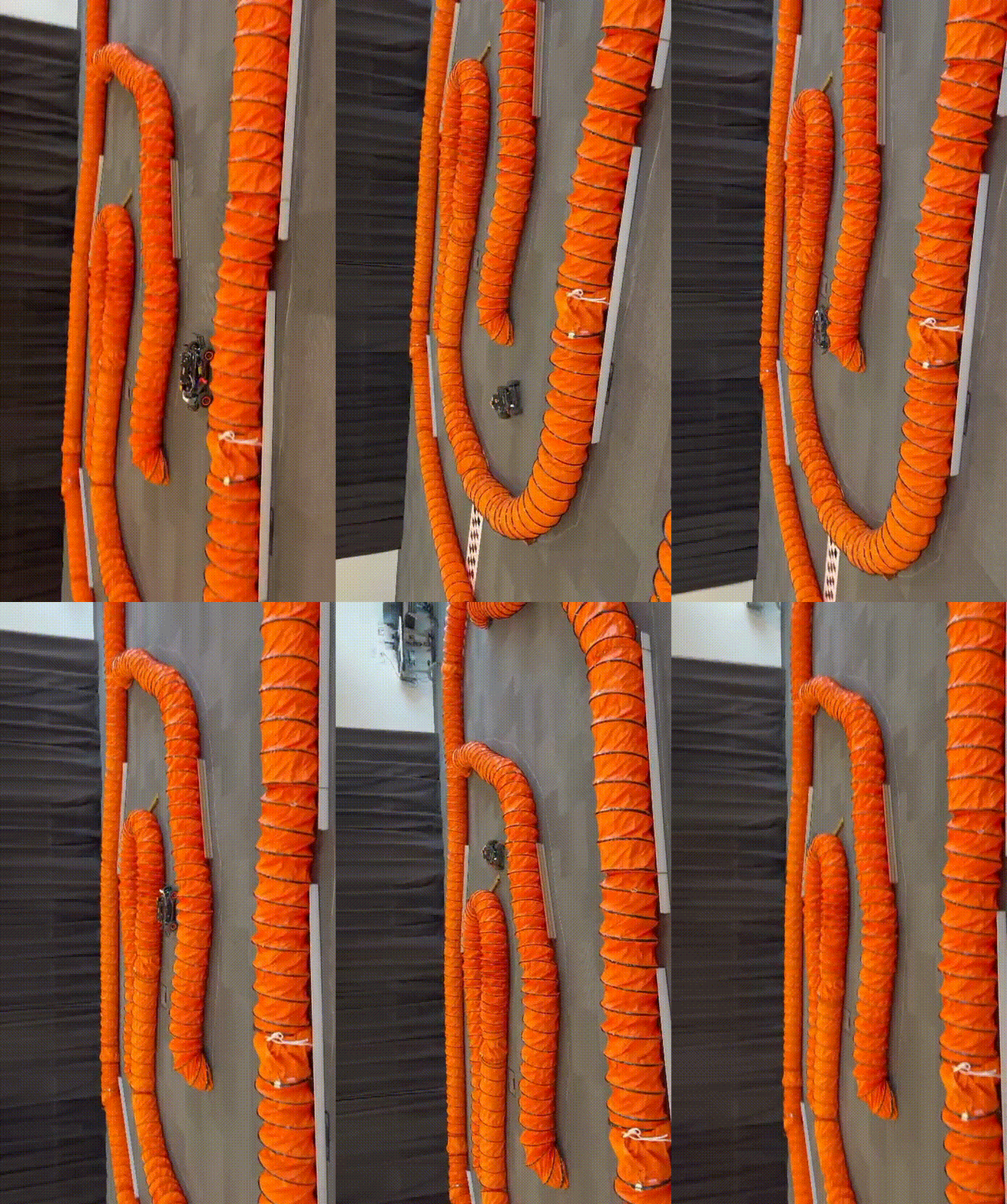
A LiDAR-based autonomy stack combining an always-on wall-balance PID controller with health-gated quadratic wall fitting for safer and faster autonomous racing.
This project was completed for UIUC's ECE 484 autonomous vehicles course. Our goal was to build a LiDAR-only autonomy stack capable of driving an unknown closed track without relying on a pre-built map.
We began with a reliable wall-balance PID controller that used the distances to the left and right walls as its primary steering signal. Although the baseline consistently completed laps, it did not always follow the true geometric centerline of the track.
To improve performance without sacrificing robustness, we added a bounded augmentation layer based on quadratic wall fitting. The final system improved centerline tracking and lap time while preserving the original controller as an always-available safety fallback. Our team ultimately placed third in the class race.
Design
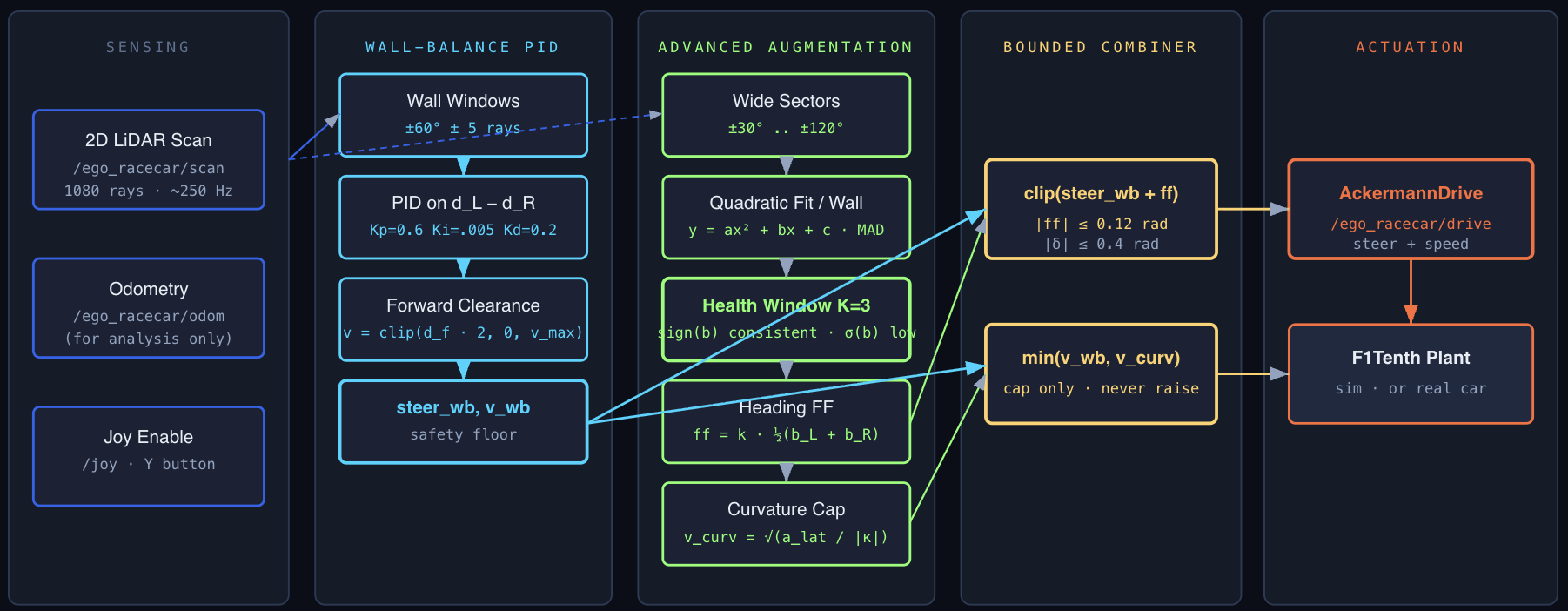
Controller architecture from LiDAR sensing through the baseline PID, bounded augmentation, and final actuation commands.
Wall-Balance PID
The baseline controller continuously samples LiDAR windows on the left and right sides of the vehicle. The difference between the average wall distances drives a PID controller, while forward LiDAR clearance determines the commanded speed.
This controller remains active at all times and acts as the system's safety floor.
Quadratic Wall Fitting
Wider LiDAR sectors are converted into point clouds and fitted with quadratic wall models. The fitted wall slopes provide a heading estimate, while the fitted curvature produces a conservative speed cap for tighter turns.
Rather than replacing the PID controller, the heading estimate is clipped and added as a bounded feedforward term. The curvature-based command may only reduce the baseline speed, never increase it.
Health-Gated Fallback
Early versions of the fit-based controller became unstable at corner entry when temporary LiDAR geometry reversed the estimated wall direction. To prevent these transient estimates from reaching the controller, we introduced a multi-frame health window.
The advanced layer is trusted only after consecutive scans agree on fit validity, slope direction, and stability. If those checks fail, the vehicle immediately falls back to the wall-balance PID.
Bounded Combiner
The final steering command combines the PID output with a clipped heading feedforward. The final speed command is the minimum of the wall-balance speed and the curvature-based cap. This structure ensures that the advanced layer can improve the baseline when its estimates are healthy, while its worst-case behavior is identical to the original controller.
Results
The bounded augmentation reduced mean cross-track error by approximately 30% and improved average lap time by 2.7%. Both tested controllers completed their runs with zero collisions.
The largest improvement occurred on straight sections, where the heading feedforward pulled the vehicle closer to the geometric centerline. The curvature-based speed cap remained intentionally conservative in tight corners.